Category Archives: Politics

AIIB will provide financial and ideological competition to the Washington institutions

The world is changing, and so is it in the banking industry. The Obama administration are concerned about the new superpower in the banking sector. It`s called AIIB, and the Obama administration has tried to stop other contries from investing in the new bank.

The reason why they have tried to stop AIIB, is because they are afraid that AIIB would undermine the power of the U.S dominated World Bank and the International Monetary Fund (IMF) in the emerging markets. So, what is AIIB, and should you be worried?

AIIB stand for The Asian infrastructure Investment Bank. It is an international financial institution proposed by the government of China. The purpose of the multilateral development bank is to provide finance to infrastructure projects in the Asia region.


AIIBMap.svg

(Picture: Prospective Founding Members (PFMs) of AIIB (2015-04-15 UTC+8 12:00:00)

  Blue dark: PFM which signed the memorandum to build AIIB
  Blue light: Approved as PFM of AIIB
  Green dark: Applying to become an ordinary member of AIIB
  Yellow: Application under consideration
  Red dark: No commitment to participate or rejected
  Grey: Uncommitted


The Bank`s foundation is built on the lessons of experience of existing MDB`s and the private sector. It`s modus operandi will be lean, clean and green; lean, with a small efficient management team and highly skilled staff.

Clean; an ethical organisation with zero tolerance for corruption; and green; an institution built on respect for the environment. The AIIB will put in place strong policies on governance, accountability, financial, procurement and environmental and social frameworks.

The AIIB, a modern knowledge-based institution, will focus on the development of infrastructure and other productive sectors in Asia, including energy and power, transportation and telecommunications, rural infrastructure and agriculture development, water supply and sanitation, environmental protection, urban development and logistics, etc. The operational strategy and priority areas of engagement may be revised or further refined by its governing boards in the future as circumstances may warrant.

AII B is regarded by some as a rival for the IMF, the World Bank and the Asian Development Bank (ADB), which are regarded as dominated by developed countries like the United States. The United Nations has addressed the launch of AIIB as «scaling up financing for sustainable development» for the concern of Global Economic Governance.

The United States officials have expressed concerns about whether the AIIB would have high standards of governance, and whether it would have environmental and social safeguards. The United States is reported to have used diplomatic pressure to try and prevent key allies, such as Australia, from joining the bank, and expressed disappointment when others, such as Britain joined.

As of April 15, 2015, almost all Asian countries and most major countries outside Asia had joined the AIIB, except the US, Japan (which dominated the ADB) and Canada. North Korea`s and Taiwan`s applications for Prospective Founding Member (PFM) were rejected.

The bank was launched at a ceremony in Beijing in October 2014. The Articles of Agreement (AOA) would be finalized and open for signature by PFM`s from June 2015. The AOA is expected to enter into force and AIIB to be fully established by the end of 2015. As of April 15, 2015 there are 57 PFM`s.

The World Bank and IMF which is dominated by Washington-based bureaucrats have had an ideological monopoly in the lending market since 1945. It all started in 1944, with the Bretton Woods Agreement.

Bretton Woods set up the World Bank and IMF duo, and provided subsidized competition to the merchant banks. This resulted in a situation were the merchant banks was driven out of the development lending business.

Lending to developing countries was carried out by the private sector before the World War II, notably by the London merchant banks. All this resulted in an attractive diversity of development banking approaches.

The problem for the recipients was that the people often got bad advice because there was only one source of long-term development capital. In the last decade, the landscape has been dotted with renewable energy projects.

Infrastructure is popular among development bankers, but it is very expensive. Huge amounts of money have been wasted over the past 70 years in attempting to develop poor countries on the basis of non-market fashionable theories from the rich West.

Africa became much poorer rather than richer from 1960 to 2000. The rest of the world became much richer, and IMF and World Bank cannot be blamed for that. The money funneled through them was both wasted and left recipient countries with often unbearable burdens of foreign debt.

The bombs the West have dropped in many Asian countries didn`t help either, and many of those countries will participate in the new bank AIIB. Some of them is Laos, Cambodia and Vietnam to name a few. Poor countries need money. Not bombs.

AIIB will provide financial and ideological competition to the Washington institutions.

This new model with Asian countries having a choice of funding sources (without Washington) will be beneficial, and the decisions will probably be free of the current Western «political correctness» doctrines.

It will be expensive and the new project will probably face huge losses to the institution concerned, but with India and Britain among its shareholders the new project will surely be one of its most benign manifestations. The multilateral development bank approach to developing poor countries has been proved over 70 years without any big success. Will AIIB change that?

It`s better with money and growth than bombs. The world can`t be held together by bombs and alliances.


Click the link below and check out the Fan Fund

https://www.eventbrite.com/e/fan-fund-tickets-15580655159


Disclaimer: The views expressed in this article are those of the author and may not reflect those of Shiny bull. The author has made every effort to ensure accuracy of information provided; however, neither Shiny bull nor the author can guarantee such accuracy. This article is strictly for informational purposes only. It is not a solicitation to make any exchange in precious metal products, commodities, securities or other financial instruments. Shiny bull and the author of this article do not accept culpability for losses and/ or damages arising from the use of this publication.

Leave a comment

Filed under Politics

Assassination attempt on the Pope

Today, on 13 May 1981, the fires attempted assassination of Pope John Paul II took place in St. Peter`s Square at Vatican City. The Pope was shot and he was struck four times and suffered severe blood loss. Who can do things like that?

The man behind this assassination attempt is Mehmet Ali Agca, born January 9, 1958, in Turkey. Agca has described himself as a mercenary with no political orientation, although he is known to have been a member of the Turkish ultra-nationalist Grey Wolves organization, which is a militant fascist group.

Agca was quoted as saying that «to me the Pope was the incarnation of all that is capitalism,» and attempted to murder him.

pope-john-paul

(Picture: Pope John Paul II in 1980)

John Paul II (born Karol Jòzef Wojtyla) is born in Poland and was the first non-Italian pope since the Dutch Pope Adrian VI, who served from 1522 to 1523. John Paul II is recognised as helping to end Communist rule in his native Poland and eventually all of Europe.

He significantly improved the Catholic Church`s relations with Judaism, Islam, the Eastern Orthodox Church, and the Anglican Communion. His wish was «to place his Church at the heart of a new religious alliance that would bring together Jews, Muslims and Christians in a great religious armada.

John Paul II had good relations with the Armenian Apostolic Church, and in 1996 he brought the Catholic Church and the Armenian Church closer by agreeing with Armenian Archbishop Karekin II on Christ`s nature.

During an audience in 2000, John Paul II had Karekin II, by then head of the Armenian Apostolic Church, issued a joint statement condemning the Armenian genocide.

The Armenian Apostolic Church is the world`s oldest national church. It is part of Oriental Orthodoxy and is one of the most ancient Christian communities. Armenia was the first country to adopt Christianity as its official religion in the early fourth century (traditionally in 301) in establishing this church.

The church claims to have originated in the mission of Apostles Bartholomew and Thaddeus in the 1st century and is an early center of Christianity. It is sometimes referred to as the Gregorian Church but this name is not preferred by the church itself, as it views the Apostles Bartholomew and Thaddeus as its founders, and St. Gregory the illuminator as merely the first official governor of the church.

Between the 16th and early 19th century, the traditional Armenian homeland composed of Eastern Armenia and Western Armenia came under rule of the rivaling Ottoman and Persian Empires, passing between the two over the centuries.

By the mid 19th century, Eastern Armenia had been conquered by Russia, while most of the western parts of the traditional Armenian homeland still remained under Ottoman rule. During World War I, the Armenians living in their ancestral lands in the Ottoman Empire were systematically exterminated in the Armenian Genocide.

After almost 600 years of statelessness, Armenia achieved Independence in 1918; however, the First Republic of Armenia, surrounded by hostile countries, was Sovietized in 1920. Between 1922 and 1991, Armenia was part of the Soviet Union.

The modern Republic of Armenia became independent in 1991.

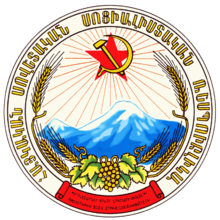
Armenian_SSR

(The coat of arms of Soviet Armenia depicting Mount Ararat in the center).


The church struggled under Soviet rules, and suffered greatly under Stalin. Fears decreased when Stalin died in 1953, and the new era with Nikita Khruschev changed peoples life in Soviet Armenia. They began to see rapid improvment.

During the Gorbachev era of the 1980`s, with the reforms of Glasnost and Perestroika, Armenians began to demand better environmental care for their country, and Gorbachev collaborated much with John Paul II.

Gorbachev once said “The collapse of the Iron Curtain would have been impossible without John Paul II.”  On John Paul II’s death, Mikhail Gorbachev said: “Pope John Paul II’s devotion to his followers is a remarkable example to all of us.”

Pope John Paul II was born in 1920 and faced deportation in Poland by the Germans, probably because he was of Jewish descent. So, he took a difficult Laborer`s job in a Stone Quarry to escape deportation and imprisonment. He also worked in War Chemical Plant to escape 1944 deportation. He worked in a chemical plant until August of 1944.

Most of the Pope`s family friends were jewish, and John Paul II became the first Pope to visit a synagogue and the first to visit the memorial at Auschwitz to victims of the Holocaust. In ending the Catholic-Jewish estrangement, he called Jews «our elder brothers.»

His father died of a heart attack in 1941, and at the age of twenty he had already lost all the people he loved. Wojtyla was the immediate family`s only surviving member. He was not at his mothers, brothers or fathers death.

When he became pope in 1978 at the age of 58, John Paul II was an avid sportsman. He was extremely healthy and active, jogging in the Vatican gardens, wight training, swimming, and hiking in the mountains. He was fond of football.

On 1 May 2011, Pope Benedict XVI attributed one miracle to John Paul II; the healing of a French nun from Parkinson`s disease. A second miracle attributed to John Paul II in 2013, confirmed by Pope Francis. (Two miracles must be attributed to a person to be declared a saint). In the years since his death, John Paul II has since been made a saint by the Roman Catholic Church. He is referred to by Roman Catholics as Pope Saint John Paul II or Saint John Paul the Great.

The three popes who today commonly are known as «Great» are Leo I, who reigned from 440-461 and persuaded Attila the Hun to withdraw from Rome; Gregory I, 590-604, after whom the Gregorian Chant is named; and Pope Nicholas I, 858-867.

John Paul II the Great is only the fourth pope to be so acclaimed, and the first since the first millenium.

According to John Lewis Gaddis, one of the most influential historians of the Cold War, the Pope`s trip to Poland led to the formation of Solidarity and would begin the process of Communism`s demise in Eastern Europe:

When Pope John Paul II kissed the ground at the Warsaw airport he began the process by which Communism in Poland and ultimately elsewhere in Europe would come to an end.

On later trips to Poland, he gave tacit support to the Solidarity organisation. These visits reinforced this message and contributed to the collapse of East European Communism that took place between 1989/1990 with the reintroduction of democracy in Poland, and which then spread through Eastern Europe (1990–1991) and South-Eastern Europe (1990–1992).

John Paul II was the catalyst for «a peaceful revolution» in Poland. The founder of Solidarity, Lech Walesa, credited John Paul II with giving Poles the courage to demand change. It has also been widely alleged that the Vatican Bank covertly funded Solidarity.

He has been credited with being instrumental in bringing down Communism in Central and Eastern Europe, by being the spiritual inspiration behind its downfall.

He was the second longest-serving pope in modern history after Pope Pius IX, who served for nearly 32 years from 1846 to 1878. Wojtyla became the 264th pope according to the chronological list of popes, the first non-Italian in 455 years.

Several theories exist concerning Mehmet Agca`s assassination attempt.

Agca was born in the Hekimhan district, Malatya Province in Turkey. As a youth, he became a pretty criminal and a member of numerous street gangs in his hometown. He became a smuggler between Turkey and Bulgaria.

He claims to have received two months of training in weaponry and terrorist tactics in Syria as a member of the Marxist Popular Front for the Liberation of Palestine paid for by the Communist Bulgarian government, although the PFLP has denied this.

After training he went to work for the far-right Turkish Grey Wolves, who were at the time destabilizing Turkey, which led to the 1980 Turkish coup dètat. It has been claimed ultranationalist Grey Wolves were being used by the CIA. For instance, according to Kendal Nezan of the Kurdish Institute of Paris, they were infiltrated and manipulated by the Operation Gladio «Stay-behind» networks, a NATO clandestine structure.

In 1979, he murdered Abdi Ipekci (Editor of the major Turkish newspaper Miliyet) under order from the Grey Wolves. He was caught due to an informant and was sentenced to life in prison. After serving six months, he escaped with the help of Abdullah Catli, second-in-command of the Grey Wolves and a prominent Gladio operative, and fled to Bulgaria, which was a base of operation for the Turkish mafia.

According to Reuters, Agca had «escaped with suspected help from sympathizers in the security services».

On 13 May 1981, Agca`s plan (according to himself) was to open fire in St. Peter`s Square and escape to the Bulgarian embassy under the cover of the panic generated by a small explosion. On May 13 he sat in the square, writing postcards and waiting for the Pope to arrive.

When the Pope passed him, Agce fired several shots and wounded him, but was grabbed by spectators and Vatican security chief Camillio Cibin and prevented from finishing the assassination or escaping.

Four bullets hit John Paul II, two of them lodging in his lower intestine, the others hitting his lift hand and right arm. Two bystanders were also hit. Celik panicked and fled without setting off his bomb or opening fire.

The Pope survived the assassination attempt.

Agca was sentenced in July 1981 to life imprisonment in Italy for the assassination attempt. After serving almost 20 years of a life sentence in prison in Italy, Agca was pardoned by the then Italian president Carlo Azeglio Ciampi in June 2000 and deported to Turkey.

Agca was extradited to Turkey in 2000 by benefiting from the Conditional Amnesty Law.

In early February 2005, durig the Pope`s illness, Agca sent a letter to the Pope wishing him well and also warning him that the world would end soon. While in prison in 2007, he claimed to convert to Christianity. He claimed to be the Messiah at his trial and has made many bizarre statements over the years, although it has never been clear whether he is mentally unstable or merely acting.

On May 2, 2008, Agca asked to be awarded Polish citizenship as he wished to spend the final years of his life in Poland, Pope John Paul II`s country of origin.

Agca was released from jail on January 18, 2010. He was transferred to a military hospital in order to assess if, at 52, he was still fit for compulsory military service. The military found him unfit for military service for having «antisocial personality disorder».

In a statement, he announced: «I will meet you in the next three days. In the name of God Almighty, I proclaim the end of the world in this century. All the world will be destroyed, every human being will die. I am not God, I am not son of God, I am Christ eternal.»

On April 2 2005, Pope John Paul II died in his private apartment of heart failure, 46 days before his 85th birthday. He had no close familiy by the time of his death. Present at the bedside was a cardinal from Ukraine, which is an heavily Orthodox nation.

The former assassin visited the tomb of John Paul II on the 27 December 2014.


Click the link below and check out the Fan Fund

https://www.eventbrite.com/e/fan-fund-tickets-15580655159


Disclaimer: The views expressed in this article are those of the author and may not reflect those of Shiny bull. The author has made every effort to ensure accuracy of information provided; however, neither Shiny bull nor the author can guarantee such accuracy. This article is strictly for informational purposes only. It is not a solicitation to make any exchange in precious metal products, commodities, securities or other financial instruments. Shiny bull and the author of this article do not accept culpability for losses and/ or damages arising from the use of this publication.

Leave a comment

Filed under Politics

Trade deficit or trade surplus

The U.S trade deficit rose to its highest level since October 2008. The U.S trade deficit rose to $51,4bn in March, which is up 43,1%. The dollar have skyrocketed and made it cheaper to buy products and services and more expensive to sell.

This makes it more expensive to export which is hurting the U.S exporters. The strength of the dollar makes it more difficult to sell products because they will be too expensive and less competitive.

The U.S has been running consistent trade deficit since 1976 due to high imports of oil and consumer products. Balance of Trade reached an all time high of $19bn in June of 1975, and a record low of -$67bn in August of 2006.


Stack of $100 bills

Consumer goods, capital and foods` imports peaked at a record high in March and petroleum imports fell to the lowest level on record. Imports of mobile phones helped increase the U.S trade deficit. U.S imports whooped 7,71 percent and its exports rose by 0,88 percent in March

On the other side, Ben Bernanke said last month that Germany`s surplus is a problem. Five years ago, U.S Treasury secretary Tim Geithner scolded Germany for its large trade surplus.

In 2013, the U.S Treasury formally rebuked Germany`s for its export successes. In 2014, the French government also presented some strange ideas on how to reduce Germany`s competitivness.

Germany posted a €19,2bn trade surplus in February 2015. Up from €16,2 a year earlier, as exports grew faster than imports.

Previous Fed Chairman Ben Bernanke has a point. Germany is benefiting from an exchange rate that is too low for its economy.

Ben Bernanke writes; «The comparatively weak euro is an underappreciated benefit to Germany of its participation in the currency union. If Germany were still using the Deutschmarks, presumably the DM would be much stronger than the euro is today, reducing the cost advantage of German exports substantially.»

Bernanke also explains why Germany`s trade surplus does not correct itself. He writes; «Systems of fixed exchange rates, like the euro union or the gold standard, have historically suffered from the fact that countries with balance of payments deficits come under severe pressure to adjust, while countries with surpluses face no corresponding pressure.»

Should Germany be part of the euro zone if their exchange rate is out of kilter, and their balance of payments surplus appears persistent just because they are part of a fixed exchange rate system?

The problem can be solved if they exit the euro zone. Their trade surplus will decline. So will its competitiveness, and their currency will appreciate. Germany is an export country like China, but the U.S is not an export country. What is the best? Surplus or deficit?

First of all; The balance of trade compares the value of a country`s exports of goods and services against its imports. When exports are greater than imports, that`s a trade surplus, which is generally considered a favorable trade balance.

When the value of imports outweighs the value of exports, is a trade deficit, and this is generally considered an unfavorable trade balance. But it all depends on where the country is in its business cycle, how long the deficit or surplus has been ongoing, and the reasons behind it.

The balance of trade is important because it`s a large component of the current account.

Countries generally try to create trade policies that encourage a trade surplus. They consider this to be a favorable trade balance because it`s like making a profit as a country. If you sell more and get higher income, then you will have more capital for your residents.

This will translate into a higher standard of living. That`s because your businesses will sustain a competitive advantage by gaining the expertise in producing everything they export. They will hire more workers, reducing unemployment and generating more income for their residents.

But U.S have a trade deficit, and Germany have a surplus. Is it good for the U.S to have deficit?

Sometimes, a trade deficit can actually be a more favorable balance of trade. It all depends on where the country is in its business cycle. If a country has a trade deficit, its imports can be raw materials which it converts to finished goods and re-exports out. A country`s trade deficit can be a result of a strong economic growth, which allows its residents to enjoy the higher standard of living.

On the other side; Romania`s dictator Nicolae Ceausescu, created a trade surplus through protectionism and forcing Romanians to save, and not spend on imports. This resulted in such a low standard of living (Source; CIA World Factbook).

But a trade surplus is not always a favorable trade balance. Japan and China are both dependent on exports to drive economic growth. To maintain this surplus, they both purchase large amount of U.S Treasuries to keep the dollar`s value high, and their value of their currencies low to make their exports competitively priced.


Click the link below and check out the Fan Fund

https://www.eventbrite.com/e/fan-fund-tickets-15580655159


Disclaimer: The views expressed in this article are those of the author and may not reflect those of Shiny bull. The author has made every effort to ensure accuracy of information provided; however, neither Shiny bull nor the author can guarantee such accuracy. This article is strictly for informational purposes only. It is not a solicitation to make any exchange in precious metal products, commodities, securities or other financial instruments. Shiny bull and the author of this article do not accept culpability for losses and/ or damages arising from the use of this publication.
Leave a comment

Filed under Politics

Armenian Genocide 1915

Today, it is 100 years since the Armenian Genocide in April 1915.

The Ottoman Empire forced Armenian civilians out of their country, marching them to prison camps and murdered as much as 1,5 million people. Christian Armenian men, woman and kids were killed, but Turkey and the United States still does not officially recognize the tragedy as a genocide.

What in the world is going on here?


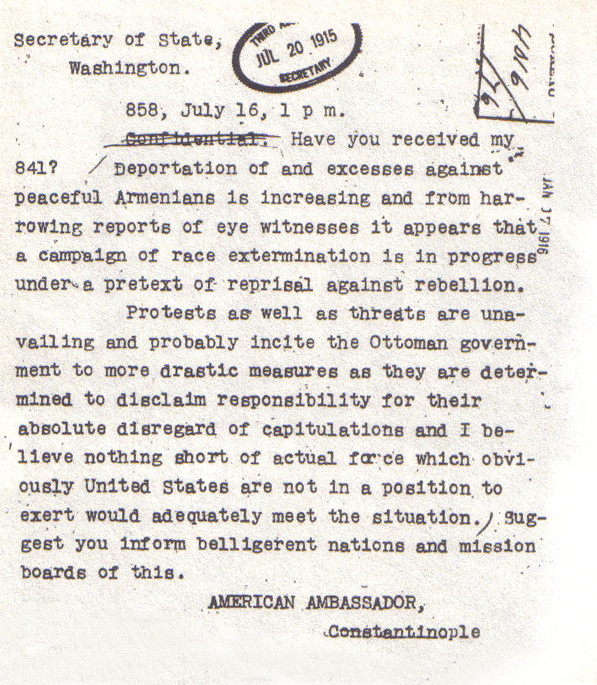
Armenian_AmbassadorMorgenthautelegram

(A telegram sent by Ambassador Henry Morgenthau, Sr, to the State Department on 16 July 1915 describes the massacres as a “campaign of race extermination”.)


The Armenian Genocide is also known as Armenian Holocaust, the Armenian massacres and, traditionally by Armenians, as Medz Yeghern («Great Crime»). The Ottoman Empire started the Genocide on 24 April 1915, arrested and executed some 250 Armenian intellectuals and community leaders in Constantinople.

The genocide was carried out during and after World War I and implemented in two phrases; the wholesale killing of the able-bodied male population through massacre and subjection of army conscripts to forced, followed by the deportation of woman, children, the elderly and infirm on death marches leading to the Syrian desert.

Driven forward by military escorts, the deportees were deprived of food and water and subjected to periodic robbery, rape, and massacre.

Raphael Lemkin was explicitly moved by the Armenian annihilation to coin the word genocide in 1943 and 1944 and define systematic and premeditated exterminations within legal parameters.

The Armenian Genocide is acknowledged to have been one of the first modern genocides.

It is because scholars point to the organized manner in which the killings were carried out in order to eliminate the Armenians, and it is the seconds most-studied case of genocide after the Holocaust. To date, 23 countries have officially recognized the mass killings as genocide.

Armenian_Morgenthau336

(Of this photo, the United States ambassador wrote, “Scenes like this were common all over the Armenian provinces, in the spring and summer months of 1915. Death in its several forms—massacre, starvation, exhaustion—destroyed the larger part of the refugees. The Turkish policy was that of extermination under the guise of deportation)”


Pope Francis spoke at the Vatican a few days ago to mark the centenary of the slaughter, and said it is «widely considered the first genocide of the 20th century». A quote from Pope John Paul II, who said some of the same words in 2001, but Pope Francis said more;

Equating the destruction of the Armenians to the Nazi Holocaust and the Soviet bloodbath under Stalin. But that`s not all. He also linked the genocidal Ottoman assault on Armenia, the World`s oldest Christian nation, with the epidemic of violence against Christians today, especially by such radical Islamist terror groups as ISIS, Boko Haram, and Al Shabab.

Turkey reacted angrily.

The Turkish foreign minister denounced the pope for fueling «hatred and animosity» with his «unfounded allegations.» The Turkish government denied, and to this day, the use of the word «genocide» to describe the killing of the Armenian is a criminal offence in Turkey.

Some Turkish authorities claim it is an international conspiracy against them. Someone who look like friends, but want to kill them. The Turkish Prime Minister claim that the Pope are joining a conspiracy of an evil front against Turkey.

Tayyip Erdogan blocked Twitter and Facebook last year. Turkey is one of the strictest internet censors in the world. Erdogan said the social media is the worst menace to society.

Hundreds of eyewitnesses, including the neutral United States and the Ottoman Empire’s own allies, Germany and Austria-Hungary, recorded and documented numerous acts of state-sponsored massacres.

Photographs exist that may suggest the Germans participated in the mass killing. One photograph shows two unidentified German army officers standing amidst human remains. The discovery of this photograph prompted English journalist Robert Fisk to draw a direct line from the Armenian Genocide to the Holocaust.

The powerful Ottoman interior minister during World War I, certainly didn`t disguise his objective. «The Government… has decided to destroy completely all the indicated (Armenians) persons living in Turkey,» he brusquely reminded officials in Aleppo in a September 1915 dispatch. «An end must be put to their existence… and no regard must be paid to either age or sex, or to conscientious scruples.»

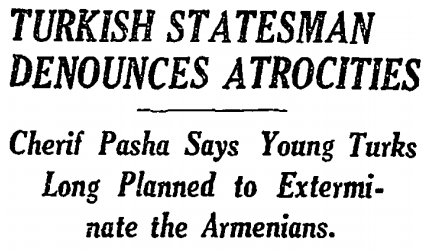
Armenians_Turkish_statesman_denounces_atrocities

(Mehmed Serif Pasha was a prominent member of the Young Turk government who, in a New York Times article dated 10 October 1915, condemned the massacres and declared that the Armenians were being “annihilated” due to CUP’s policies).


Eitan Belkind was a Nili member who infiltrated the Ottoman army as an official. He was assigned to the headquarters of kamal Pasha. He claims to have witnessed the burning of 5,000 Armenians. Lt. Hasan Maruf of the Ottoman army describes how a population of a village were taken all together and then burned. Vahakn Dadrian wrote that 80,000 Armenians in 90 villages across the Mus plain were burned in «stables and haylofts».

Trabzon was the main city in Trabzon province; Oscar S. Heizer, the American consul at Trabzon, reported: “This plan did not suit Nail Bey… Many of the children were loaded into boats and taken out to sea and thrown overboard”. (This exactly whats going on in Libya today).

Dr. Ziya Fuad and Dr. Adnan, public health services director of Trabzon, submitted affidavits reporting cases in which two school buildings were used to organize children and send them to the mezzanine to kill them with toxic gas equipment.

Jeremy Hugh Baron writes: “Individual doctors were directly involved in the massacres, having poisoned infants, killed children and issued false certificates of death from natural causes.

About 2 million Armenian lived in the country in 1914 (before the genocide started). By 1918, 10 percent was left. Many was killed while others fled for their lives. The percentage of non-Muslims in Turkey fell from 19 percent in 1914 to 2,5 percent in 1927. Less than 0,2 percent is non-Muslims in Turkey at the moment.

Turkey is now a secular state with no official state religion. Islam is the dominant religion of Turkey with 99,8 percent of the population being registered as Muslim. That`s more than Iran at 99,4 percent.

The Armenians were not only victims of genocide, but also of jihad. The jihadists of 1915 murdered «bishops, priests, religious men and woman, the elderly and defenseless children and the infirm.

Eyewitnesses want to remind us that the jihadist savagery of ISIS and Al Qaeda is not an innovation.


Click the link below and check out the Fan Fund

https://www.eventbrite.com/e/fan-fund-tickets-15580655159


Disclaimer: The views expressed in this article are those of the author and may not reflect those of Shiny bull. The author has made every effort to ensure accuracy of information provided; however, neither Shiny bull nor the author can guarantee such accuracy. This article is strictly for informational purposes only. It is not a solicitation to make any exchange in precious metal products, commodities, securities or other financial instruments. Shiny bull and the author of this article do not accept culpability for losses and/ or damages arising from the use of this publication.

Leave a comment

Filed under Politics

What is TPP?

European Union`s (EU) got competition, and the new competitor is TPP. The economic power of this group is 40% larger than EU, and the TPP agreement came into effect in 2006.

The Trans-Pacific Partnership (TPP) is a proposed regional regulatory and investment treaty. The proposed agreement began in 2005 as the Trans-Pacific Strategic Partnership Agreement (TPSEP or P4).

The TPSEP was previously known as the Pacific Three Closer Economic Partnership (P3-CEP), and it`s negotiations was launched on the sidelines of the 2002 APEC Leaders` Meeting in Los Cabos, Mexico, by Prime Ministers Helen Clark of New Zealand, Goh Chok Tong of Singapore and Chilean President Ricardo Lagos.

TPP_map

(Green dark; Currently in negotiations   Green light; Announced interest in joining   Blue; Potential future members)


All original and negotiating parties are members of the Asia-Pacific Economic Cooperation (APEC). The TPSEP and TPP are not APEC initiatives, but the TPP is considered to be pathfinder for the proposed Free Trade Area of the Asia-Pacific (FTAAP), an APEC initiative.

(21 APEC countries account for about 45% of global trade. They also make up some 40% of the world`s population).

It is a comprehensive agreement, affecting trade in goods, rules of origin, trade remedies, sanitary and phytosanitary measures, technical barriers to trade, trade in services, intellectual property, government procurement and competition policy.

Among other things, it called for reduction by 90 percent of all tariffs between member countries by 1 January 2006, and reduction of all trade tariffs to zero by the year 2015.

On the last day of the 2010 APEC summit, leaders of the nine negotiating countries endorsed the proposal advanced by US President Barack Obama that set a target for settlement of negotiations by the next APEC summit in November 2011. However, negotiations have continued through 2012, 2013 and 2014.

Japan officially joined the TPP negotiations on 23 July 2013. According to the Brookings Institution, Prime Minister Abe’s decision to commit Japan to joining the TPP should be understood as a necessary complement to his efforts to stimulate the Japanese economy with monetary easing and the related depreciation of the Yen. These efforts alone, without the type of economic reform the TPP will lead to, are unlikely to produce long-term improvements in Japan’s growth prospects.

Members and potential members are Brunei, Chile, New Zealand, Singapore, United States, Australia, Peru, Vietnam, Malaysia, Mexico, Canada, Japan, Taiwan and Republic of Korea. South Korea is interested in joining the club. So are Taiwan, Philippines, Laos, Colombia, Indonesia, Cambodia, Bangladesh and India.

China and Thailand is also interested in joining the TPP club.

The negotiations goes on and it seems to be difficult for some countries to make an agreement which causes delays. Wikileaks’ exposure of the Intellectual Property Rights and Environmental chapters of the TPP revealed “just how far apart the US is from the other nations involved in the treaty, with 19 points of disagreement in the area of intellectual property alone.

One of the documents speaks of ‘great pressure’ being applied by the US.” Australia in particular opposes the US’s proposals for copyright protection and an element supported by all other nations involved to “limit the liability of ISP`s for copyright infringement by their users.” Another sticking point lies with Japan’s reluctance to open up its agricultural markets.

According to The Nation`s interpretation of leaked documents in 2012, countries would be obliged to conform all their domestic laws and regulations to the TPP’s rules, even limiting how governments could spend their tax dollars.

As of 2012, US negotiators were pursuing an investor-state dispute settlement mechanism, also known as corporate tribunals, which can be used to attack domestic public interest laws.

This mechanism is a common provision in international trade and investment agreements, that grants an investor the right to initiate dispute settlement proceedings against a foreign government in their own right under international law. For example, if an investor invests in country “A”, a member of a trade treaty, and country A breaches that treaty, then the investor may sue country A’s government for the breach.

Critics of the investment protection regime argue that traditional investment treaty standards are incompatible with environmental law, human rights protection, and public welfare regulation, meaning that TPP will be used to force states to lower standards e.g., environmental and workers protection, or be sued for damages. The Australian government’s position against investor state dispute settlement has been argued to support the rule of law and national energy security.

On March 26, 2015 WikiLeaks released the TPP’s Investment Chapter. According to WikiLeaks, the accord would grant the power to global corporations to sue governments in tribunals organized by the World Bank or the United Nations to obtain taxpayer compensation for loss of expected future profits due to government actions.

Another contentious issue of the TPP negotiations has been currency manipulation, wherein a country devalues its currency to boost exports and gain a trade advantage.

Politicians such as Senator Lindsey O. Graham and Representative Sander M. Levin “gathered a group of economists, manufacturing industry officials and labor leaders who agreed that the TPP should die unless it credibly prohibits countries from manipulating the value of their currency.”

Many economists claim that currency manipulation by Asian manufacturing countries has become pervasive, “allowing them to boost their exports at the expense of manufacturing companies in the United States and Europe.”

Furthermore, organisations such as the WTH or IMF cannot control such currency manipulation, so some are calling upon the US to “use the free-trade talks to force an end to such actions.”

A keynesian economist, Joseph Stiglitz, warned that the TPP presented «grave risks» and «serves the interests of the wealthiest.»

Organized labour in the U.S argued that the trade deal would largely benefit corporations at the expense of workers in the manufacturing and service industries. The Economic Policy institute and the Center for Economic and Policy Research argued that the TPP could result in further job losses and declining wages.

Global Intellectual Property Center (GIPC) has another point of view. In intellectual property (IP)-intensive sectors alone, more than 55 million jobs generate 74% of U.S exports, creating jobs at home while establishing the U.S as a leader in innovation and creativity.

A high standard TPP agreement would provide an opportunity to empower other nations to harness their innovative potential while also fostering American jobs and promoting U.S most cutting-edge industries.

Office of the United States Trade Representative says TPP will make it easier to sell Made-in-America goods and services exports to some of the most dynamic and fastest growing markets in the world, and support homegrown jobs and economic growth.

American small businesses are the backbone of the U.S economy, and have accounted for nearly two-thirds of new private sector jobs in recent decades. The TPP will improve transparency and regulations to help U.S companies engage in and benefit from increased trade in the Asia-Pacific.

The Trans-Pacific Partnership will grow trade with one of the world`s fastest growing regions, Office of the United States Trade Representative said.


Click the link below and check out the Fan Fund

https://www.eventbrite.com/e/fan-fund-tickets-15580655159


Disclaimer: The views expressed in this article are those of the author and may not reflect those of Shiny bull. The author has made every effort to ensure accuracy of information provided; however, neither Shiny bull nor the author can guarantee such accuracy. This article is strictly for informational purposes only. It is not a solicitation to make any exchange in precious metal products, commodities, securities or other financial instruments. Shiny bull and the author of this article do not accept culpability for losses and/ or damages arising from the use of this publication.
Leave a comment

Filed under Politics