
Tag Archives: US Dollar

The Global Debt Crisis is an Unseen Time Bomb

When discussions about debt dominate the headlines, the United States is often the central focus. With a debt-to-GDP ratio of 124.3%, it’s easy to understand why. But the U.S. is far from alone in facing a massive fiscal challenge. Other advanced economies are carrying even heavier burdens, and the global implications are both profound and often overlooked.

Japan: The Debt Giant

Japan holds the world’s highest debt-to-GDP ratio at 236.7%. Decades of low growth, heavy public spending, and an aging population have pushed the country into uncharted fiscal waters. While Japan has avoided crisis thanks to strong domestic savings and near-zero interest rates, the sustainability of this model is under constant scrutiny.

Italy: Europe’s Weak Link

Close behind is Italy, with a staggering 135,3% debt-to-GDP ratio. Burdened by structural economic weaknesses, sluggish productivity, and political instability, Italy has long been considered one of the eurozone’s most fragile economies. A sudden shock, whether financial or political, could easily ripple across the European continent.

The United States: A Growing Concern

At 124.3%, U.S. debt levels are higher than at any point since World War II. Unlike Japan, the U.S. relies heavily on international investors to finance its debt. Rising interest rates and political gridlock over fiscal policy only increase the risks. Given the U.S. dollar’s central role in the global financial system, instability in this market could have widespread consequences worldwide.

France and Canada: Silent Strugglers

France, at 113%, and Canada, at 110.8%, are also far above the traditional sustainability threshold (often pegged at around 60% of GDP). Both countries face demographic pressures, high social spending, and the challenge of funding welfare states without stifling economic growth.

Why It’s Unsustainable

High debt levels limit governments’ flexibility. In times of crisis, whether another pandemic, a war, or a financial meltdown, nations with already bloated balance sheets have little room to maneuver. Debt servicing costs also divert resources away from critical areas, such as healthcare, education, and infrastructure.

A Global Time Bomb

The global debt problem isn’t isolated. The IMF warns that mounting debt in advanced economies could spill over into emerging markets, sparking instability across the financial system. With inflation still high and interest rates rising, debt servicing costs are growing rapidly. Unless meaningful reforms are enacted, the world may be heading toward a reckoning.

Conclusion

It’s easy to point fingers at the U.S., but the debt problem is truly a global issue. Japan, Italy, France, and Canada. All highly developed nations are carrying unsustainable debt loads that could destabilize the global economy. For now, markets remain calm, but history has shown that debt crises often strike suddenly and with devastating force. Without coordinated efforts to rein in borrowing and restore fiscal discipline, the next major crisis may already be quietly brewing.

Disclaimer: The views expressed in this article are those of the author and may not reflect those of Shinybull.com. The author has made every effort to ensure the accuracy of the information provided; however, neither Shinybull.com nor the author can guarantee the accuracy of this information. This article is strictly for informational purposes only. It is not a solicitation to make any exchange in precious metal products, commodities, securities, or other financial instruments. Shinybull.com and the author of this article do not accept culpability for losses and/ or damages arising from the use of this publication.

Leave a comment

Filed under Emerging markets, Politics

The world is experiencing revolutionary changes with Eurasian Integration in a multipolar world

The world is changing very fast, and we are facing a massive shift in the global markets. A New World Order. And President Vladimir Putin talked about it in his speech at the second Eurasian Economic Forum in Moscow, Russia, on May 24, 2023.

The Eurasian Economic Union (EAEU) supports pairing with China`s Belt and Road Initiative (BRI) to achieve the Greater Eurasian Partnership, Putin said in his speech at the second Eurasian Economic Forum of the EAEU on Wednesday.

EAEU is an economic union of countries located in Eurasia, consisting of five member states: Russia, Belarus, Kazakhstan, Kyrgyzstan, and Armenia.
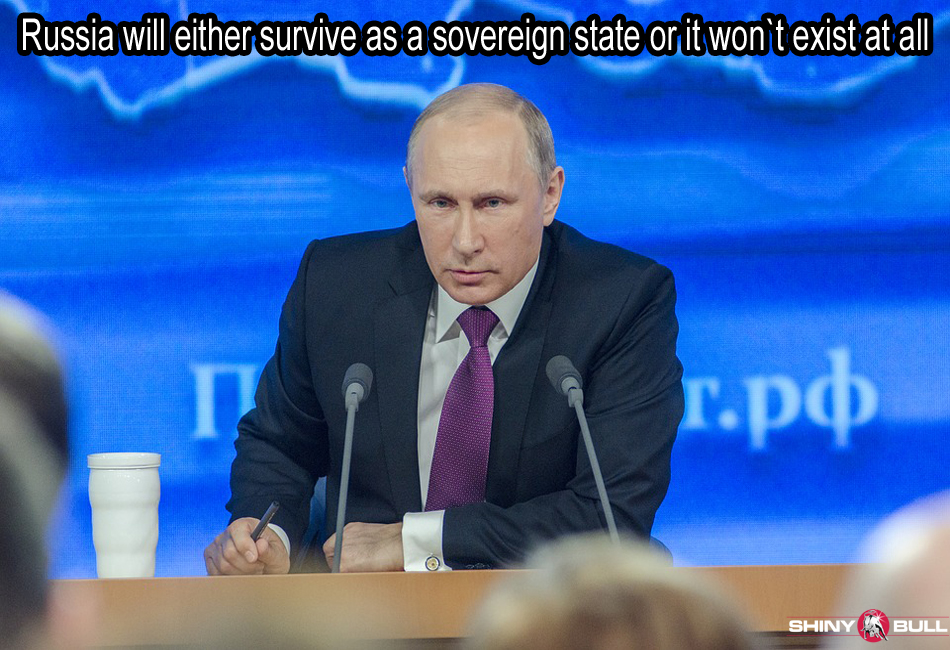
50 different countries attended the economic forum in Moscow under this motto: «Eurasian Integration in a multipolar world.»

The forum is designed to look at ways in which BRICS, the EAEU, and the Shanghai Cooperation Organization (SCO) can be expanded, and possibly integrated.

Putin said the EAEU supports initiatives committed to developing the Eurasian region and will continue to work with China to promote the docking of the EAEU`s development with China`s BRI.

Putin also said that the world is experiencing revolutionary changes and that more countries are seeking to build a new architecture of international economic relations that is fairer, and based on mutual respect and mutual benefit.

The speech was interesting, and Putin added that the U.S. economic policy is «shooting itself in the foot» by reinforcing a trend that undermines its own development. In this regard, he said Russia and its partners in the EAEU are interested in «honest, productive, and pragmatic cooperation,» noting that anyone acting otherwise «damages the global economy.»

Putin talked a lot about the economy, and he argued that the global economic system will only benefit from the formation of a decentralized international financial system and that it`s important to coordinate efforts to form such a global system.

Echoing Putin`s call for a decentralized international financial system, Belarusian First Deputy Prime Minister Nikolai Snopkov said on Wednesday that Belarus plans to completely move away from the U.S dollar, and the euro in trade with Russia, and other EAEU countries by 2023.

But Belarus is not alone to do that. A few days ago, the Iraqi Ministry of Interior imposed a ban on the use of US dollars in personal, and commercial transactions in Iraq, according to Iraq News.

The ban, which came into force a few days ago, aims to promote the use of the local currency, the Iraqi dinar and limited the use of the US dollar in Iraq.

The De-Dollarisation wave continues………

Disclaimer: The views expressed in this article are those of the author and may not reflect those of Shinybull.com. The author has made every effort to ensure the accuracy of the information provided; however, neither Shinybull.com nor the author can guarantee such accuracy. This article is strictly for informational purposes only. It is not a solicitation to make any exchange in precious metal products, commodities, securities, or other financial instruments. Shinybull.com and the author of this article do not accept culpability for losses and/ or damages arising from the use of this publication.

Leave a comment

Filed under Politics

PM Liz Truss will make the biggest tax cuts since 1985

Those of you who are old enough can remember the 80s. Not only the music from the 80s but politics on the right side. UK`s PM Margareth Thatcher and US President Ronald Reagan. Two characters who did so much great for the world.

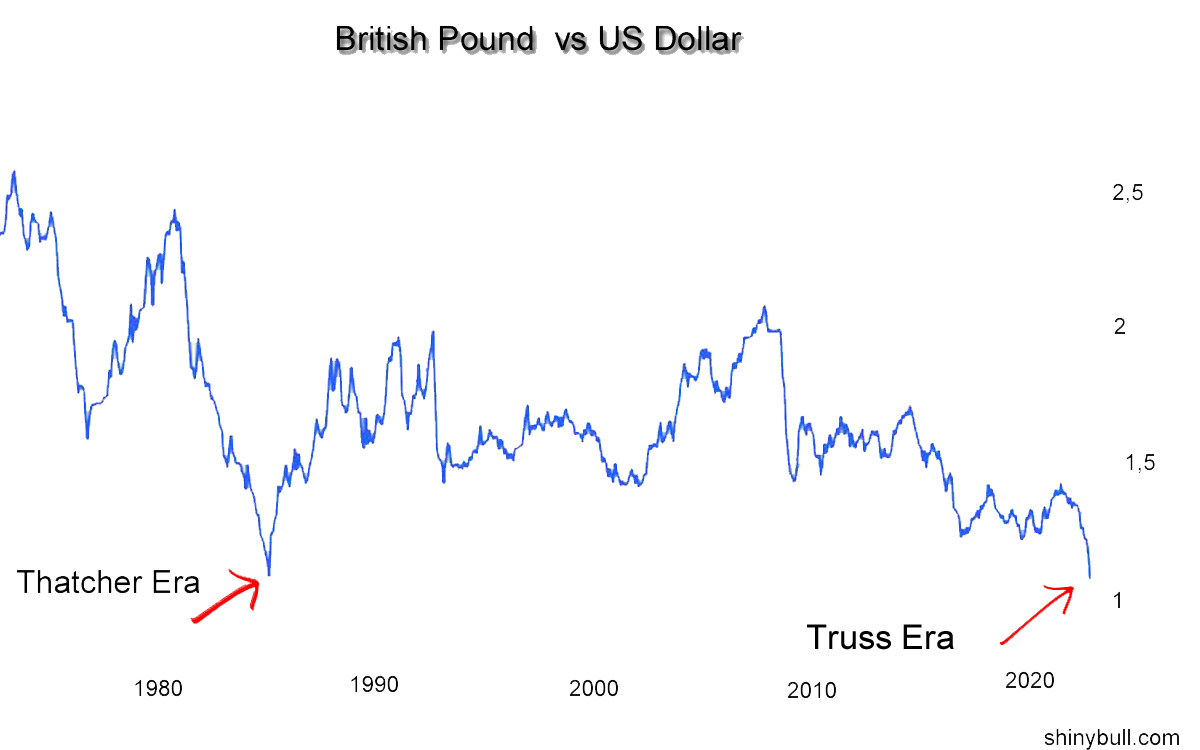
Take a closer look at the pound. It`s 1 against the US dollar. Just like it was in the ’80s. The economy in the UK is in trouble, but PM Liz Truss wants to do something about that. And what she`s planning to do is very similar to Trump’s policy: tax cuts.

Liz Truss is pro-growth, and this is similar to Giorgia Meloni`s policy. They are both dismissed as extremists, and people are worried. Truss is also pro-fracking, and she will end the ban on fracking from oil and gas.

On top of that, she will provide relief for rising energy costs, reduce to the income tax rate, and slash corporate and payroll taxes. This is very similar to Trumponomics. If not to say; Reaganomics. And if Liz Truss can do all this, she can become the UK`s next Margareth Thatcher.

Many people believe that the more tax people pay, the more the government earns. But it isn`t that easy, and it doesn`t always work like this. When you raise taxes, very often we can see that revenues are declining.

I like to see a cheap pound because it makes me buy things from the UK very cheap. The lower the pound is, the cheaper the products are. Not only that. A lot of people around the world will take their next trip to the UK because of a lower pound. It means a party for the rest of us, and that can boost the economy in the UK. This is bullish.

Italy is doing the same. Meloni will cut taxes as well, and people are worried. They call them both extremists and neo-fascists. But they are the opposite. Let`s wait and see.

Disclaimer: The views expressed in this article are those of the author and may not reflect those of Shinybull.com. The author has made every effort to ensure the accuracy of the information provided; however, neither Shinybull.com nor the author can guarantee such accuracy. This article is strictly for informational purposes only. It is not a solicitation to make any exchange in precious metal products, commodities, securities, or other financial instruments. Shinybull.com and the author of this article do not accept culpability for losses and/ or damages arising from the use of this publication.

Leave a comment

Filed under Politics