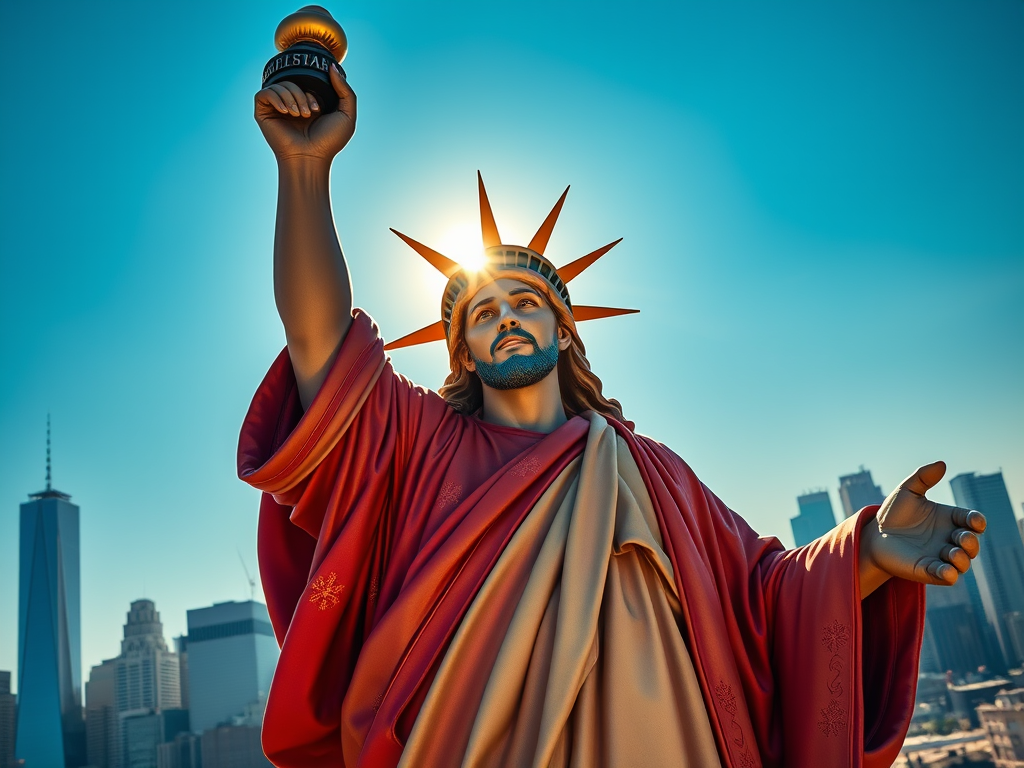
More than two thousand years after Jesus from Israel warned humanity about moral blindness and abused authority, the same struggle continues. Across the world, authoritarian and theocratic regimes still silence their people in the name of righteousness, while democracies wrestle with the price of freedom. From Tehran to Gaza, from social media censorship to satellite internet, the battle over truth, speech, and human dignity remains the defining conflict of our time.
More than two thousand years ago, Jesus from Israel confronted the leaders of his time with a striking observation: “You know how to interpret the appearance of the sky and the earth, but you cannot interpret the present moment.” His warning was not about astronomy or weather—it was about moral clarity. About the danger of power that loses humility, and authority that speaks of God while denying justice, truth, and human dignity.
That tension remains painfully relevant today.
Authoritarian Power and Moral Inversion
Iran presents one of the clearest modern examples of moral inversion. The country is ruled not by its people, but by a theocratic power structure dominated by clerics loyal to the Supreme Leader. This is not a faith community acting in good conscience, but a closed ruling elite that uses religious language to legitimize repression.
Institutions such as the Islamic Revolutionary Guard Corps (IRGC) function as both internal enforcers and external operators, crushing dissent at home while exporting violence abroad. The regime openly funds and arms groups such as Hezbollah in Lebanon and Hamas in Gaza—organizations that operate outside democratic norms and deliberately target civilians.
The stated goal of this alliance is ideological confrontation, particularly the destruction of Israel. Yet the human cost of this agenda is borne by ordinary people: Israeli civilians living normal lives under constant threat, Palestinians trapped between militant groups and humanitarian collapse, and above all, the Iranian population itself.
Inside Iran, protests are met with internet shutdowns, mass arrests, torture, and executions. Women are beaten or killed for defying dress codes. Journalists disappear. Students are imprisoned. Minorities are silenced. The regime that claims moral authority has shown none toward its own people.
Israel, Self-Defense, and the Collapse of the Narrative
Iran’s clerical leadership routinely labels Israel “the Great Satan.” But when words are weighed against actions, the accusation collapses. Israel, a democratic state, acts primarily in self-defense against groups that openly call for its destruction and have launched decades of rocket attacks, suicide bombings, and kidnappings.
Crucially, Israel is not targeting ordinary Palestinian civilians in Gaza. Its operations are aimed at Hamas and other militant groups responsible for terror attacks. Innocent civilians, while tragically caught in the conflict, are not the objective.
The same principle applies to Iran. If outside powers, such as the United States or Israel, intervene in Iran, their focus would be on the criminal theocratic rulers and their armed networks—the same groups that finance and coordinate terrorist organizations like Hamas and Hezbollah—not the Iranian people themselves, who suffer under the oppressive regime.
Meanwhile, the Iranian regime projects accusations of evil outward while systematically repressing its own citizens, silencing women, journalists, and students, and sponsoring violence abroad. Moral hypocrisy is evident: evil is claimed elsewhere, but practiced at home and through proxies.
Democracy vs. Theocracy
At its core, this is not merely a geopolitical struggle—it is a philosophical one.
Democracy rests on the principle that power flows from the people, that leaders are accountable, and that truth can be debated openly. A theocracy, by contrast, claims divine authority, places rulers beyond question, and treats dissent as heresy. Where democracy depends on free speech and transparency, authoritarian systems survive through censorship, fear, and isolation.
This is why free information is the greatest enemy of such regimes.
Why the Internet Terrifies Tyranny
When the Iranian regime shuts down the internet, it is not a technical decision—it is a political act of survival. Open communication exposes corruption, abuse, and lies. Free speech breaks the illusion of absolute power.
That is why the smuggling of Starlink satellite terminals into Iran matters. Backed by Elon Musk’s satellite network, this technology bypasses state-controlled infrastructure and restores a basic human freedom: connection to the outside world. Information becomes resistance.
Musk’s role here is consistent with his stated philosophy. He bought Twitter to restore what he called a digital public square, reversing bans—including that of a sitting U.S. president—on the grounds that democracy cannot function if political speech is arbitrarily silenced. While social media debates moderation, the Iranian regime cuts off an entire nation from the internet. The contrast could not be clearer. Elon Musk is a freedom champion. So is Trump.
A Timeless Warning
Jesus was not executed for promoting kindness alone. He was killed for challenging power structures that cloaked themselves in divine authority while denying truth and justice. His message threatened those who ruled through fear, hypocrisy, and control.
History keeps repeating the same lesson: regimes that silence truth in the name of righteousness ultimately condemn themselves. Power without humility corrupts. Authority without accountability collapses. And those who fear open speech reveal their own illegitimacy.
Two thousand years later, the struggle continues—but so does the truth.

Disclaimer: The views expressed in this article are those of the author and may not reflect those of Shinybull.com. The author has made every effort to ensure the accuracy of the information provided; however, neither Shinybull.com nor the author can guarantee the accuracy of this information. This article is strictly for informational purposes only. It is not a solicitation to make any exchange in precious metal products, commodities, securities, or other financial instruments. Shinybull.com and the author of this article do not accept culpability for losses and/ or damages arising from the use of this publication.
 Ket Garden
 Business, Politics, Finans