
Tag Archives: U.S President

Lincoln and Kennedy: Coincidence or Something More?

For decades, people (including me/the editor) have been fascinated by the strange parallels between Abraham Lincoln and John F. Kennedy. Both were elected to Congress exactly 100 years apart, became president 100 years apart, were assassinated on a Friday, and were succeeded by men named Johnson. Their killers even share oddly similar details in their names.

At first glance, it almost feels supernatural—like history repeating itself in perfect rhythm. But is it really a mystery?

Historians point out that much of the similarity comes from selective perception. Out of the thousands of differences in their lives and presidencies, people naturally highlight the few coincidences that line up neatly. This is a classic example of confirmation bias: our brains are wired to notice patterns, even when they’re random.

Some “coincidences” are also simplified or exaggerated in retellings. For instance, John Wilkes Booth wasn’t really born in 1839 (he was born in 1838), and not every detail lines up perfectly. The myth has grown stronger as the story is passed along, making it sound more mysterious than it actually is.

So why do these parallels feel so compelling? Psychologists say it’s because humans crave meaning. We don’t like to think of history as chaotic or random; we prefer to imagine deeper connections. When two of America’s most famous presidents share some eerie overlaps, it’s easy to weave them into a narrative that feels fated.

Let`s take a closer look at all the coincidences, so we all can make up our own minds. What do you think? Is it a coincidence, and if not, what is it?

Did You Know? The Strange Coincidences Between Lincoln and Kennedy

Did you know that Abraham Lincoln and John F. Kennedy share a series of coincidences that almost sound too incredible to be true?

Lincoln was elected to Congress in 1846, while Kennedy followed exactly one century later, in 1946. Lincoln became president in 1860, and Kennedy in 1960. Both men placed civil rights at the heart of their political agendas.

The parallels don’t stop there. Both presidents were shot in the head, on a Friday, and both were succeeded by men named Johnson—Andrew Johnson (born 1808) after Lincoln, and Lyndon B. Johnson (born 1908) after Kennedy.

Even their assassins show a strange pattern. Lincoln’s killer, John Wilkes Booth, was born in 1838. Kennedy’s assassin, Lee Harvey Oswald, was born in 1939. Each is remembered by all three of their names—and each name contains exactly 15 letters.

The settings are equally eerie: Lincoln was shot in Ford’s Theatre, while Kennedy was shot in a Lincoln car, made by Ford. Booth fled a theater and was captured in a barn. Oswald fired from a warehouse and was captured in a theater.

Coincidence? Maybe. But the uncanny parallels between Lincoln and Kennedy have fascinated historians and the public alike for decades.

If It Isn’t Coincidence: The Mystery of Lincoln and Kennedy

For over half a century, people have wondered: could the eerie parallels between Abraham Lincoln and John F. Kennedy be more than mere coincidence?

If we set aside the skeptics’ explanations of chance and pattern-seeking, a few intriguing possibilities emerge.

Some imagine history as a cycle, repeating itself in hidden rhythms. In this view, Lincoln and Kennedy weren’t just two presidents separated by a century—they were actors cast in the same recurring drama, destined to face similar trials at similar moments in America’s story.

Others lean toward mystical explanations. Perhaps the two men were linked by fate, or even reincarnation: the same soul returning to guide the nation in moments of upheaval. Civil rights, unity, and the fight against division marked both presidencies. Was Kennedy continuing a mission Lincoln began? And what about MLK, who was a Civil rights Champion? Also, he was shot.

There’s also a conspiratorial lens. If powerful forces engineered both assassinations, the similarities might not be accidents at all, but deliberate echoes—details designed to send a chilling message across generations.

And then there’s the possibility of a psychological pattern. Maybe leaders who challenge the status quo—who push too hard on civil rights and equality—are always bound to meet resistance, no matter the century. The echoes we notice could simply be the shadow of power repeating itself.

Whether it’s fate, conspiracy, or the cycles of history, one thing is sure: the Lincoln–Kennedy parallels continue to haunt us, because deep down, we sense that history is never entirely random.

The Lincoln–Kennedy Enigma

Some call it a coincidence. Others whisper of fate.

A century apart, two men rose to lead America. Both spoke of unity, of civil rights, of a brighter tomorrow. Both carried the weight of a divided nation. And both met their end in the same way—on a Friday, by a bullet to the head.

Lincoln and Kennedy. Different centuries, same story. Their successors bore the same name. Their killers mirrored each other, right down to the letters in their names. The pattern is too precise, too elegant, too cruel to dismiss as chance.

So what is it?

Is history caught in a loop, replaying itself like a record that can’t escape the groove? Are Lincoln and Kennedy two faces of the same destiny—one soul returning, unfinished business in hand? Or is it something darker? A hidden hand, weaving events to prove a point: that power never forgets, and those who challenge it will always fall in the same way.

The facts are real. The parallels are undeniable. What they mean… remains a mystery.

Maybe it’s a coincidence.
Maybe it’s fate.
Or maybe… It’s the shadow of history itself.

The Hidden Hand

They call it a coincidence. But in the dark corners of history, whispers tell of something else—the Hidden Hand.

The theory goes like this: whenever a leader rises to challenge the old order, to push too far, too fast, the Hidden Hand intervenes. It doesn’t wear a face. It doesn’t sign its name. It moves quietly, shifting events, nudging fate, until the outcome is sealed.

Lincoln, they say, stood in the way of a fractured nation healing on its own terms. He forced the issue—slavery, equality, the very definition of freedom. The Hand moved. Booth pulled the trigger.

A century later, Kennedy dared to dream of civil rights, peace with enemies, and a future outside the control of those who profited from conflict. Again, the Hand moved. Oswald fired from the window.

But who—or what—is the Hidden Hand?

Some say it is not a who at all, but a network: secret societies, power brokers, the guardians of wealth and order. Others believe it is older than governments, older than money—a force that ensures balance by cutting down those who rise too high.

The evidence is never written in books, never proven in courts. It lives in patterns, in eerie coincidences, in the silence that follows a gunshot.

Perhaps the Hand is real. Perhaps it is only the shape our minds give to chaos. But if it is real, one truth remains: it is still here, waiting, watching… ready to move again.

The Lincoln–Kennedy Code

Some say history is random. Some say it is written. Others… say it is programmed.

In the shadows, beyond the eyes of ordinary citizens, a code runs silently, threading events together like lines of invisible text. Lincoln and Kennedy—they were anomalies in the system. Two points of interference, two glitches in the simulation, pulling at the edges of the Matrix.

Lincoln rose to challenge the rules of his time, daring to rewrite the moral algorithm of a nation. Kennedy, a century later, attempted to push the code even further, to open pathways the system never intended. And in each case, the system corrected itself. A gunshot. A Friday. A succession meant to restore balance.

The Hidden Hand, some theorists whisper, is not human. It is the program itself, self-correcting, adjusting the loops of history to prevent the simulation from destabilizing. Every coincidence—the names, the dates, the letters in assassins’ names—was a sign of the underlying code, a signature left for those who could see.

But the anomaly persists. Those who notice the patterns, who question why history repeats with such precision… they are the exceptions. And exceptions, in the Matrix, are dangerous.

Lincoln. Kennedy. The pattern is unfinished. The code is still running. And somewhere, beyond the veil of what we call reality, the system watches, calculates… and waits.

The Simulation

What if everything we know—history, life, even death—is not real? What if reality itself is a simulation, a construct designed to test, to teach, or simply to observe?

Some patterns seem too precise to be random. Lincoln and Kennedy, separated by a century yet eerily linked by dates, names, and deaths—are they just coincidences, or are they markers in the code? Every anomaly, every “glitch” in history, could be the system correcting itself, nudging events so the simulation stays on course.

Perhaps we are all characters in a program we cannot see, playing roles assigned long before we were born. Some of us notice the glitches: the strange parallels, the déjà vu, the moments when history repeats itself with impossible precision. And those who notice… are awakened, aware that the world is not what it seems.

Lincoln. Kennedy. The patterns are clues. The simulation is still running. And somewhere, unseen, the programmer watches, shaping reality one line of code at a time.

Short summary:

Lincoln–Kennedy Coincidences

  • Lincoln was elected to Congress in 1846.
  • Kennedy was elected to Congress in 1946.
  • Lincoln became president in 1860.
  • Kennedy became president in 1960.
  • Both were strongly concerned with civil rights.
  • Both were shot in the head on a Friday.
  • Both were succeeded by a Johnson:
    • Andrew Johnson (born 1808), after Lincoln
    • Lyndon B. Johnson (born 1908), after Kennedy
  • Both assassins are known by their three names, each with 15 letters:
    • John Wilkes Booth
    • Lee Harvey Oswald
  • Lincoln was shot in Ford’s Theatre.
  • Kennedy was shot in a Lincoln car made by Ford.
  • Booth fled a theater and was caught in a barn.
  • Oswald shot from a warehouse and was caught in a theater.

Disclaimer: The views expressed in this article are those of the author and may not reflect those of Shinybull.com. The author has made every effort to ensure the accuracy of the information provided; however, neither Shinybull.com nor the author can guarantee such accuracy. This article is strictly for informational purposes only. It is not a solicitation to make any exchange in precious metal products, commodities, securities, or other financial instruments. Shinybull.com and the author of this article do not accept culpability for losses and/ or damages arising from the use of this publication.

Leave a comment

Filed under Curiosity, Uncategorized

John F. Kennedy`s 100th birthday

John Fitzgerald «Jack» Kennedy could have been 100 years on Monday, but someone wanted it different. John F Kennedy, better known as JFK, was born in Brookline, Massachusetts on May 29, 1917. Hundred years ago.

He died at the age of 46. He was assassinated in Dallas, Texas on November 22, 1963. JFK was an American politican who served as the 35th President of the United States. A member of the Democratic Party.

The murder of JFK changed America. It also changed the world. We can still see a lot of terrorist attacks and assassination attempts and it is not only an attack on a few but an attack on the society. An attack on the democracy.
In the 1960 presidential election, Kennedy narrowly defeated incumbent Vice President and Republican opponent Richard Nixon.

Kennedy served at the height of the Cold War, and much of his presidency focused on managing relations with the Soviet Union. His time in office was marked by high tensions with Communist states.

JFK increased the number of American military advisers in South Vietnam by a factor of 18 over President Dwitht D. Eisenhower. In April 1961, he authorized a failed joint-CIA attempt to overthrow the Cuban government of Fidel Castro in the Bay of Pigs Invasion.

He subsequently rejected plans by the Joint Chiefs of Staff to orchestrate false-flag attacks on American soil in order to gain public approval for a war against Cuba.

In October 1962, U.S spy planes discovered that Soviet missile bases had been deployed in Cuba; the resulting period of tensions, termed the Cuban Missile Crisis, nearly resulted in the breakout of a global thermonuclear conflict.

Domestically, Kennedy presided over the establishment of the Peace Corps and supported the Civil Rights Movement, but he was largely unsuccessful in passing his New Frontier domestic policies.

Kennedy was assassinated in Dallas, Texas, and Lee Harvey Oswald was arrested for the crime, but never went to trial due to his murder by Jack Ruby.

The FBI and the Warren Commission officially concluded that Oswald was the lone assassin, but various groups belived that Kennedy was the victim of a conspiricy.

John F Kennedys father (Joe) was a politican but also a businessman. All four of his grandparents were children of Irish immigrants. Joes business kept him away from the family for long stretches of time, and his ventures were concentrated on Wall Street and Hollywood.

In September 1927, Joe and the rest of his family moved to Bronx, New York. That`s only a few years before the Great depression, but in 1929, the family purchased their home Hyannis Port, Massachusetts, and their winter home in Palm Beach, Florida, later purchased in 1933.

1n September 1935, Kennedy made his first trip abroad when he traveled to London with his parents and his sister Kathleen, but Ill-health forced his return to America in October of that year, when he enrolled late and spent six weeks at Princeton Univerity. He had to leave after two months due to a gastrointestinal illness.

Kennedy tried out for the football, golf and swimming teams and earned a spot on the varsity swimming team. Kennedy also sailed in the Star Class and won the 1936 Nantucket Sound Championship.

In July 1937, Kennedy sailed to France, taking his convertible, and apent ten weeks driving through Europe with Billings. In June 1938, Kennedy sailed overseas with this father and older brother to work at the American embassy in London, where his father was President Franklin D. Roosevelts U.S Ambassador to the Court of St. Jamess.

In 1939, Kennedy toured Europe, the Soviet Union, the Balkans, and the Middle East in preparation for his Harvard senior honors thesis. He then went to Czechoslovakia and Germany before returning to London on September 1, 1939, the day that Germany invaded Poland to mark the beginning of World War II.

As an upperclassman at Harvard, Kennedy became a more serious student and developed an interest in political philosophy. In his junior year, he made the Dean`s List. In 1940, he completed his thesis, «Appeasement in Munich», about British participation in the Munich Agreement.

The thesis became a bestseller under the title «Why England Slept.» In addition to addressing Britain`s failure to strengthen its military in the lead-up to World War II, the book called for an Anglo-American alliance against the rising totalitarian powers.

While Kennedy became increasingly supportive of U.S intervention in World War II, his fathers isolationist beliefs resulted in the latters dismissal as ambassador to the United Kingdom, creating a split between the Kennedy and Roosevelt families.

The United Kingdom and United States have been close allies in numerious military and political conflicts throughout the 20th and 21th centuries including World War I, World War II, the Korean War, the Cold War, the Gulf War, and the War on Terror.


(A poster from World War I showing Britannia arm-in-arm with Uncle Sam symbolizing the Anglo-American alliance)


Do you think it was a close rase between Bush and Gore? What about Trump and Clinton? You think it was a close race? Take a look at JFK and Nixon. It was a time were the medium of television began to play a dominant role in politics.

Kennedy`s campaign gained momentumm after the first debate, and he pulled slightly ahead of Nixon in most polls. On November 8, Kennedy defeated Nixon in one of the closest presidential elections of the 20th century.

In the national popular vote, by most accounts, Kennedy led Nixon by just two-tenths of one percent (49,7% to 49,5%), while in the electoral Collage, he won 303 votes to Nixon`s 219 (269 were needed to win).

Fourteen electors from Mississippi and Alabama refused to support Kennedy because of his support for the civil rights movement.

Kennedy became the youngest person ever elected to the presidency, though Theodore Roosevelt was slightly younger when he took office after William McKinley`s death in 1901.

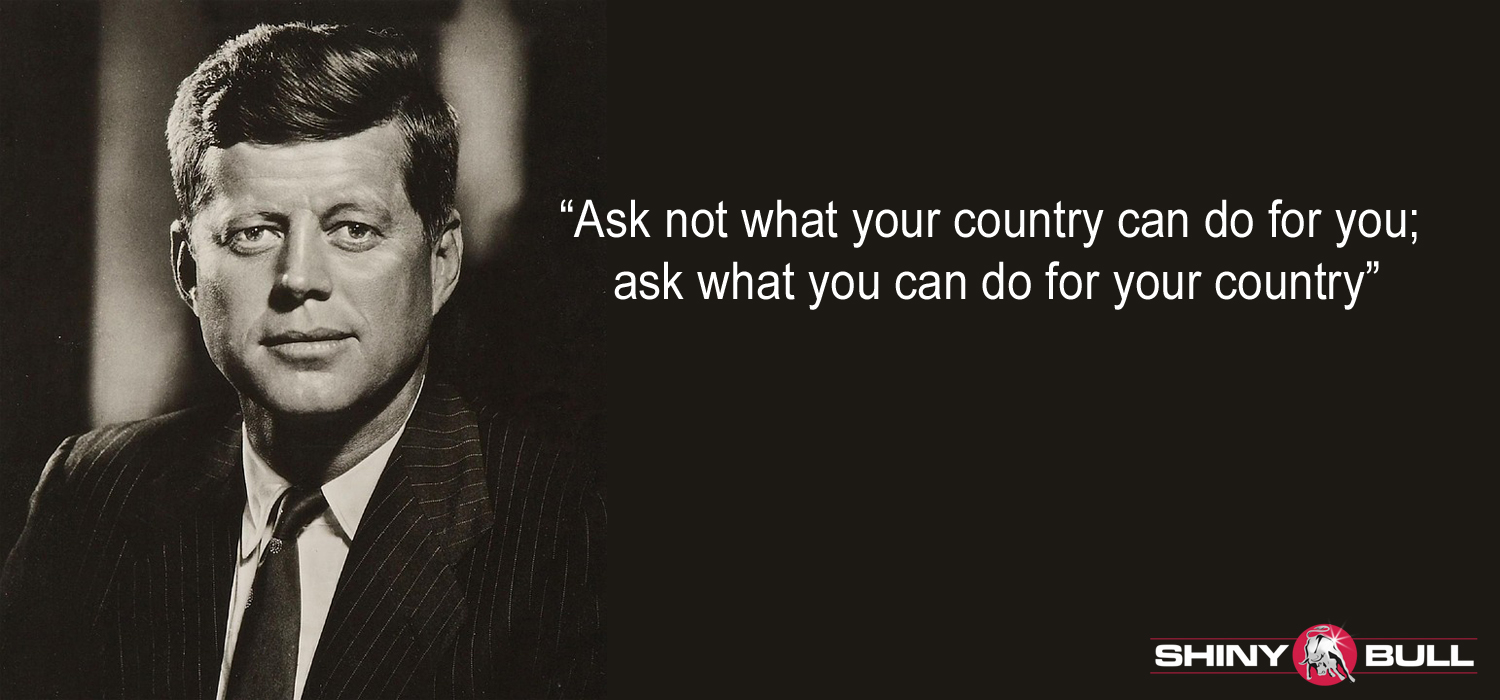
John F. Kennedy was sworn in as the 35th president at noon on January 20, 1961. In his inagurational address he spoke of the need for all Americans to be active citizens, famously asking: «Ask not what your country can do for you; ask what you can do for your country.»

He asked the nations of the world to join together to fight what he called the «common enemies of man: tyranny, poverty, disease, and war itself. He added;

“All this will not be finished in the first one hundred days. Nor will it be finished in the first one thousand days, nor in the life of the Administration, nor even perhaps in our lifetime on this planet. But let us begin. In closing, he expanded on his desire for greater internationalism: Finally, whether you are citizens of America or citizens of the world, ask of us here the same high standards of strength and sacrifice which we ask of you.”


Disclaimer: The views expressed in this article are those of the author and may not reflect those of Shiny bull. The author has made every effort to ensure accuracy of information provided; however, neither Shiny bull nor the author can guarantee such accuracy. This article is strictly for informational purposes only. It is not a solicitation to make any exchange in precious metal products, commodities, securities or other financial instruments. Shiny bull and the author of this article do not accept culpability for losses and/ or damages arising from the use of this publication.

Leave a comment

Filed under Politics