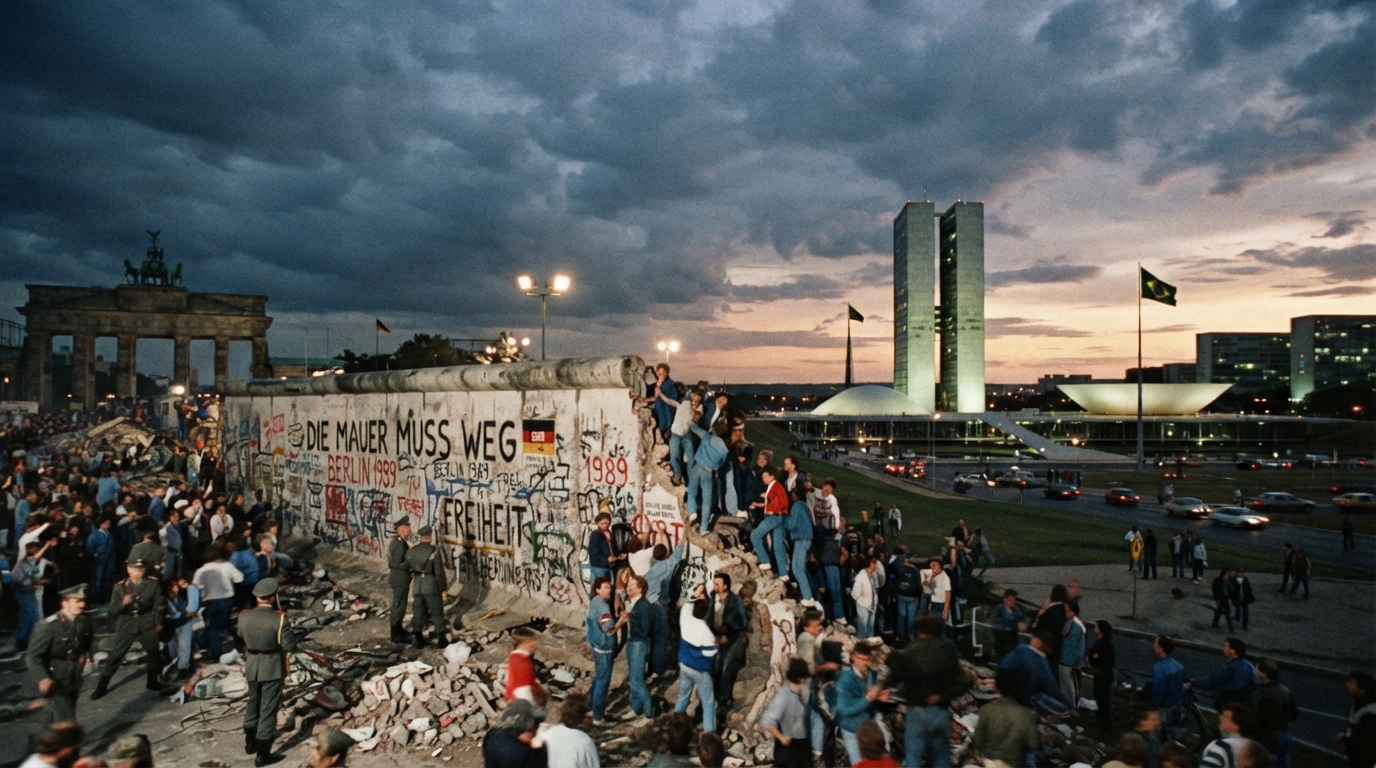
When the Berlin Wall fell in November 1989, it was as if the world held its breath.
The Cold War was over. The Soviet Union was heading toward collapse. The United States stood as the dominant superpower, and across the West there was a growing conviction that the great ideological struggle had been won. Market economics, liberalization and globalization would shape the new century.
Francis Fukuyama’s famous thesis about the “end of history” captured the spirit of the age. It was not necessarily history itself that was supposed to end, but the belief that there was any serious alternative to the liberal world order.
In Latin America, history was soon to prove otherwise.

São Paulo, 1990
Only months after the fall of the Berlin Wall, representatives of the Latin American left gathered in São Paulo.
The meeting, held in July 1990, had been convened by two very different political figures who nevertheless saw the same historical development taking shape: Fidel Castro of Cuba and Brazil’s Luiz Inácio Lula da Silva. They brought together 48 parties and organizations from Latin America and the Caribbean to discuss what the fall of the Berlin Wall, the Washington Consensus and the new global situation meant for the left.
It was not the creation of a new communist bloc. On the contrary, the meeting brought together a broad mixture of socialist, social-democratic and other left-wing movements. What united them above all was opposition to the economic and political direction that was gaining the upper hand after the Cold War.
The name Foro de São Paulo, the São Paulo Forum, was adopted the following year at a meeting in Mexico City.
What emerged was an important arena for the Latin American left in the decades that followed. While the Soviet Union disappeared and communist parties in Europe lost much of their former influence, the left in Latin America was trying to find a new path.
History had not ended.
It had simply moved.
The Pendulum Begins to Swing
During the 1990s, many Latin American countries went through market reforms, privatization and economic liberalization. The Washington Consensus became something of a political roadmap. For many, the reforms brought economic stability. For others, they became the very symbol of a development in which inequality persisted while national control over the economy weakened.
By the end of the decade, the pendulum began to swing.
Hugo Chávez won the Venezuelan presidency in 1998. Néstor Kirchner came to power in Argentina in 2003. Evo Morales became president of Bolivia in 2006, Rafael Correa in Ecuador in 2007. And in Brazil, Lula was about to achieve his historic breakthrough.
What later became known as the Latin American “pink tide” was neither a single ideology nor a unified political movement. But country after country elected governments that wanted a stronger state, greater social equality and more distance from traditional U.S. dominance in the region.
Brazil was the largest country and the region’s economic heavyweight.
And Lula was heading for Brasília.
Lula Arrives in Brasília
In 2002, Lula won the presidential election.
The story of the metalworker and trade union leader who became president carried an almost symbolic power. But it was not a revolution that moved into the presidential palace.
Lula retained the market economy while giving the state a stronger role in combating poverty and inequality. Social programs lifted millions of Brazilians out of poverty, while Brazil simultaneously pursued a more ambitious foreign policy.
This was where Brazil’s story began to acquire a broader geopolitical significance.
Lula did not want Brazil to choose between the United States and the rest of the world. Brazil itself was to become a power.
That meant stronger ties with countries of the Global South, closer cooperation with India and South Africa, and a clearer ambition to reform institutions established after the Second World War.
Soon, this policy acquired a name that would become increasingly important.
BRIC.
BRIC Takes Shape
The term BRIC was originally coined by Goldman Sachs economist Jim O’Neill in 2001. Brazil, Russia, India and China were identified as emerging economies that could acquire far greater importance in the global economy.
But creating an economic label was one thing.
Turning it into a political project was another.
That happened in the years that followed. Foreign ministers from the four countries began meeting in 2006, and in 2009 the first summit was held in Yekaterinburg, Russia. The following year, the leaders met in Brasília. Brazil was therefore not the originator of the acronym itself, but the country – with Foreign Minister Celso Amorim among its key architects – played an important role in turning BRIC into a political forum.
The message was not that the world should become communist.
It was something else: that the international balance of power should no longer be dominated by the United States and the old Western institutions alone.
At the 2009 BRIC summit, the leaders called, among other things, for a more representative international financial architecture and a more multipolar world order.
It was an important historical shift.
For the first time since the Cold War, major non-Western powers were beginning to build institutions and forms of cooperation that had not been created in Washington or Brussels.
And Brazil stood at the center of it.
Beijing Moves In
At the same time, something else was happening that would transform Brazil’s place in the world.
China was rising.
Brazil’s economic relationship with the United States remained extensive, and its historic ties with Europe did not disappear. But trade with Asia grew dramatically. In 2009, China overtook the United States as Brazil’s largest trading partner.
It was more than a statistical change.
Brazil possessed enormous resources that China needed: soybeans, iron ore, oil and other commodities. China, in turn, offered a huge and rapidly expanding market, with an economic weight that made the country increasingly important to Brazil.
A remarkable situation emerged.
Brazil remained politically and culturally close to the West, while economically becoming ever more deeply integrated with Asia.
That combination would later make Brazil so interesting in the struggle over the new world order.
Because Brazil could not simply choose a side.
Bolsonaro Comes to Power
Then came the reaction.
In 2018, Jair Bolsonaro won the presidency. The former army captain and longtime congressman made opposition to the left a central part of his political identity.
Bolsonaro was national-conservative, strongly anti-communist and closely aligned with Donald Trump. For the first time in many years, Brazil had a president openly seeking closer ties with the American right.
But foreign policy could not be changed as easily as political rhetoric.
China was already Brazil’s most important trading partner. BRICS had become an established part of Brazilian foreign policy. Brazil depended on export revenues from the Chinese market.
Bolsonaro could criticize Beijing.
He could admire Trump.
But Brazil could not simply detach itself from China.
This was one of the great paradoxes of the Bolsonaro years: Brazil’s political orientation moved to the right and closer to Washington, while economic reality tied the country ever more closely to Asia.
Then came 2022.
The Day Brasília Exploded
The election between Lula and Jair Bolsonaro became one of the most polarized in Brazil’s modern history.
Lula narrowly won the second round.
Bolsonaro did not formally refuse to acknowledge the result, but his political movement continued to challenge the election outcome. Demonstrators gathered outside military bases, and the conflict surrounding the election developed into a deep democratic crisis.
On January 8, 2023, it exploded.
Thousands of Bolsonaro supporters stormed Congress, the Supreme Court and the presidential palace in Brasília. The buildings meant to symbolize the Brazilian republic were vandalized by demonstrators who believed the election result should be overturned.
The images travelled around the world.
For Brazil, January 8 became a national trauma. For the outside world, it became a symbol of how far political polarization had gone.
But the events can also be seen in a broader historical context.
Brazil’s conflict was no longer simply about left and right.
It was about the direction the country would take – politically, economically and geopolitically.
The World Is No Longer the Same
In 2003, when Lula first entered the presidential palace, the United States was the world’s clearly dominant superpower. China was rising, but it had not yet acquired the global weight it has today.
Russia was weaker than the Soviet Union had been. India was less integrated into the global economy. BRICS did not yet exist as a political organization.
That makes it difficult to understand today’s Brazil without looking at the transformation taking place around it.
The United States remains a major power. Europe remains a central economic and political force. But China has acquired a completely different position. India is growing. Russia has sought closer cooperation with powers outside the West. And BRICS has developed far beyond its original circle.
This is not a new Cold War.
It is something more complicated.
A world in which several centers of power are trying to shape the rules.
And Brazil finds itself in the middle of it.
The New Election
That is why the 2026 presidential election is more than another chapter in the long-running conflict between Lula and the Bolsonaro family.
On October 4, Flávio Bolsonaro, Jair Bolsonaro’s eldest son, won 47.03 percent of the valid vote in the first round. Lula received 45.16 percent. Neither candidate secured a majority, and the two will therefore face each other in the runoff on October 25.
Flávio Bolsonaro is a clear ally of Donald Trump. The election has therefore acquired an international dimension that extends far beyond Brazil’s borders.
At the same time, Bolsonaro’s Liberal Party made major gains in Congress. The party increased its representation in the Senate from 15 to 28 seats and is expected to hold 121 of the 513 seats in the lower house. Together with other right-wing parties, the bloc could exercise considerable influence over the legislature.
The election is therefore not simply about who will occupy the presidential palace in Brasília.
It is also about the political direction Brazil will take in the years ahead – and how the country will position itself in a world where the balance of power is changing.
A Country Between Two Worlds
It is tempting to see Brazil as a country that must choose between Washington and Beijing.
But history points in another direction.
For decades, Brazilian foreign policy has sought to preserve room for maneuver between the great powers. Lula pursued this through cooperation with countries of the Global South and through BRICS. Bolsonaro sought closer ties with the United States, but could not change the economic realities that had made China Brazil’s largest trading partner.
The underlying Brazilian strategy has therefore been more stable than the political rhetoric might suggest.
Brazil wants influence.
Brazil wants strategic autonomy.
And Brazil wants to be large and powerful enough to speak to several sides at once.
That is precisely what makes the country so important in the emerging world order.
What Really Came After 1989?
The Berlin Wall fell in 1989, but the world did not stand still.
In Latin America, the left reorganized itself. In São Paulo, Lula, Fidel Castro and a broad circle of Latin American left-wing parties met to discuss what should come after the Cold War. A few years later, the political left came to power across much of the region.
In Brazil, Lula became president.
BRIC became BRICS.
China emerged as Brazil’s largest trading partner.
Bolsonaro took the country in another political direction and aligned himself more closely with Trump and the American right.
Then came January 8.
And now Lula and the Bolsonaro family face each other once again.
It is more than a Brazilian election.
It is a reminder that the history that followed 1989 did not unfold in the way many in the West expected.
The liberal world order did not disappear. But neither did it remain unchallenged.
Countries such as Brazil sought greater distance from a world in which power had long been concentrated in Washington and Europe. China built its own global weight. BRICS became an expression of the desire for a more multipolar world. At the same time, Brazil remained deeply connected to the United States and Europe.
That tension is what makes Brazil so important.
Brazil at Another Crossroads
When Brazilians go to the polls on October 25, they will not simply be choosing between two presidential candidates.
They will be doing so in a country that has undergone a remarkable political journey since the fall of the Berlin Wall.
From Lula and Fidel Castro in São Paulo in 1990 to BRICS and Beijing. From Lula to Bolsonaro. From the Trump alliance to the storming of Brasília. And now back to a new confrontation between Lula and the Bolsonaro family.
Over 36 years, Brazil has gone from being a regional power on the periphery of the Cold War system to becoming one of the most important states in the emerging struggle between the world’s competing centers of power.
That is why the history of Brazil is also a history of the world.
When the Berlin Wall fell, many believed that the great ideological struggle was over.
Brazil tells a different story.
Perhaps 1989 was not the end of the struggle over how the world should be organized.
Perhaps it was the year the struggle for the next world order began.